
Reading City Directory Shelves
Historical directory research in Reading starts with a careful inventory, not an assumed run of books. The Pennsylvania Room at Reading Public Library confirms archived City of Reading telephone directories and telephone books, along with suburban Berks volumes. Its public holdings page does not identify every year, publisher, or reverse-directory volume. That limit matters. A specific volume is evidence for one place and period, while a missing volume or an absent name needs another check. The local shelf works best when the request gives staff a name spelling, street address, and an estimated year.
| Reading collection | Verified period or scope | Repository | How to reach it |
|---|---|---|---|
| City telephone directories and books | Archived, exact run not published | Reading Public Library Pennsylvania Room | Noncirculating, staff-assisted local research |
| Suburban Berks telephone directories | Archived, exact run not published | Reading Public Library Pennsylvania Room | On-site reference, useful after a city-edge move |
| Reading Directory and City Register | 1856-57 title specifically cited | Berks History Center context | Confirm volume and access with the archive |
| Reading Sanborn maps | 1887, 48 sheets; 1920 volume 2, 50 sheets | Library of Congress | Free digitized building and street context |
| Federal population schedules | 1790-1950, latest open schedule 1950 | National Archives and local research collections | Household evidence, subject to each schedule's fields |
Use a telephone-book entry as a dated lead, not a complete household roster. Reading has no verified continuous digitized directory collection in the available local research. Call first when a year is essential, and keep the volume title, page, repository, and date in the research notes.
Reading City Directories at the Pennsylvania Room
The Pennsylvania Room at Reading Public Library is the practical first stop for historical directory work. It is a noncirculating Reading-and-Berks collection with staff assistance, maps, cemetery and church material, census sources, yearbooks, and newspaper access beside the archived telephone books. The room is at the Main Branch, 100 South Fifth Street, and its published local-history hours are Friday 12-4:30 p.m. and Saturday 9:30 a.m.-4 p.m. The direct research line is 610-655-6355.
The Pennsylvania Room local-history collection is shown here as an on-site research channel for a Reading historical-volume question.

Bring the earliest and latest year that matter, plus alternate spellings and a street name. Staff can confirm whether a volume, newspaper reel, yearbook, map, or local index is available without promising that an unlisted person never lived in Reading.
Note: The library calls these holdings archived telephone directories and books, so a request for a named publisher or a complete year run should be verified before relying on it.
Reading's Earliest City Directory
One early title is firmly identified: a Berks History Center article cites the Reading Directory and City Register for 1856-57. That is valuable proof of an early Reading directory, but it does not establish a first publication year, a publisher sequence, or an unbroken set on any one shelf. Treat catalog references to discrete years such as 1806, 1860, and 1864 as leads that require a title, scan, repository, and rights check before they become a citation.
Reading's address history also needs context. The City was surveyed in 1748, with Penn Street as its east-west spine, and Fifth Street was once called Callowhill. Many street names changed in 1833. A name or number that looks unfamiliar in an old directory may need a map or legal-description comparison rather than a quick conclusion that the entry refers to another place.
- 1748: Reading was surveyed and laid out.
- 1833: Many local street names changed, including the earlier Callowhill name for Fifth Street.
- 1856-57: The Reading Directory and City Register is specifically cited by Berks History Center material.
- 1887 and 1920: Digitized Sanborn map sets provide dated street and building context around directory research.
How to Read a Reading Directory Entry
No readable official scan of a Reading directory entry or its abbreviation key was available in the local research. That is a reason to inspect the actual volume's introductory pages before interpreting a line. Write down what the book itself labels, including the alphabetic name, initials or family notation, street number and street, business or residence indication if present, cross-street, and page or section. A telephone subscriber line can be narrower than a fuller city-directory entry.
| Exact name form | Copy spelling, initials, suffixes, and any family notation exactly as printed. |
|---|---|
| Street location | Record the number, street, and any cross-street or section reference before comparing maps. |
| Supplementary notation | Preserve a work, business, residence, or relationship notation only when the volume's own legend explains it. |
| Volume reference | Keep the title, year, page, and repository so another researcher can inspect the same entry. |
- Criss-cross directory
- A reverse or street-order volume that may list an address before a name. The local public holdings page does not verify a Reading run, so ask whether one exists for the year needed.
- Householder index
- An index arranged around a dwelling or head-of-household concept. Its fields and coverage depend on the specific book.
- Abbreviation key
- The legend supplied by a volume. Photograph or transcribe it before assigning meaning to an unfamiliar mark.
Requesting a Reading Reverse Directory
A street address requires a different question from a name search. Ask Pennsylvania Room staff for a reverse, criss-cross, householder, street, or classified volume for the target year. The official public page verifies telephone books, but not the years or existence of a reverse run. A staff member may be able to check the shelf or catalog, while an archive can confirm a related historical collection.
If a reverse volume is unavailable, work in both directions: find a name in the alphabetic book, record the address, then compare the prior and next available volumes. Pair that result with a deed, census, map, or newspaper notice. The modern address-keyed trail belongs on the Reading street directory page; historical books are strongest when they narrow a time interval instead of being asked to prove a current occupant.
Reading Directories Beside Census and Maps
Directories gain force when another dated record tells the same story. The 1887 Reading Sanborn map has 48 sheets, and the 1920 Reading Sanborn volume has 50. These maps can show a street layout, building footprint, construction or use notation, and map-era address context. They do not name a household. Use the map to test whether a structure or old street configuration fits the directory entry.
The National Archives census information confirms public schedules through 1950. From 1850 through 1950, schedules may supply household names, ages, birthplaces, relationships, and often street information, though the fields change by year. The 1890 population schedules were largely destroyed in a 1921 federal fire, not a Berks courthouse disaster. For that gap, compare a directory or telephone book with deeds, tax material, newspapers, and the 1880 and 1900 censuses.
Note: A matching address on a Sanborn sheet establishes building context, while a matching census entry establishes a household at the census date; neither replaces the other.
Reading Archive Indexes Beyond Directories
The Berks History Center research library adds library collections, historical reviews, church records, cemetery indexes, and the PASSING SCENE Index. Its research library is at 160 Spring Street in Reading, with appointment research listed Wednesday through Saturday, 9 a.m.-3 p.m. The published nonmember admission is $7, while members and valid-ID students are free. Its remote research service is another option for a focused question with a name, address, era, and variant spellings.
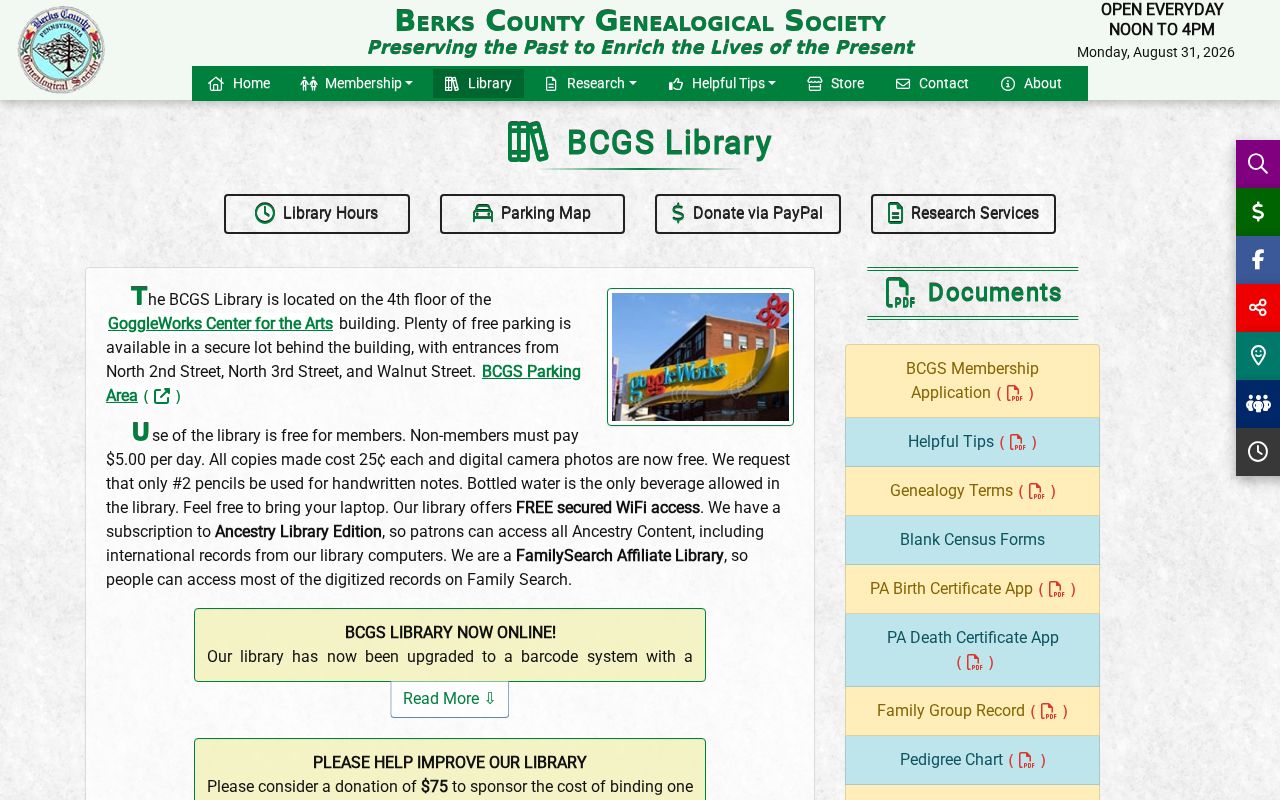
The Berks County Genealogical Society Library supplies another local research channel for church, cemetery, census, newspaper, and other area material. Its GoggleWorks location is useful when a Reading family trail leaves the telephone books. Church and cemetery index results are leads, not relationship proof. Request the underlying register, marker source, obituary, vital record where eligible, or probate paper before joining people with the same surname.
The Berks County Genealogical Society Library provides this additional Reading historical research setting.
Use the libraries for historical context, then use the custodian that holds a deed, estate file, certificate, or municipal record when a conclusion needs a primary document.
Tracing Families Through Reading Directories
For a family trail, begin with the nearest confirmed Reading directory year and move outward in small steps. A change in address may show a move, a changed household arrangement, a spelling change, or an omission. It does not settle the reason by itself. Reading Eagle material at the Pennsylvania Room can offer a dated obituary or notice, and probate or cemetery sources can test a possible exit from the record. Keep uncertainty visible when the evidence is thin.
- Locate the closest available telephone book or directory volume and transcribe the name and address exactly.
- Check the next earlier and later available volumes for the same spelling, a variant, or the same address.
- Compare the address with a Sanborn sheet or Recorder legal description when the street name or number has changed.
- Pair the interval with the closest available federal census, beginning with 1950 and moving backward.
- Use an obituary, cemetery index, or Register of Wills file as a lead for a move, death, or estate transition.
A directory absence can mean a move, no telephone service, a different name form, or a publication choice. It is not proof that a person was never in Reading. For an address-specific backward chain of prior households, use the Reading previous residents search after recording the historical address evidence.