
Records Behind a Reading Resident Lookup
A useful Reading resident lookup begins by matching the record to the question. An address can lead to the Berks assessment record, but that record identifies an assessed owner and may show a tax contact rather than the person who lives there. A deed names parties to a recorded transaction. A docket names parties to a public case. Historical certificates and marriage material have their own custody rules. Treat each result as one piece of evidence, not as a profile.
| Record | What It Confirms | Where to Search | Access |
|---|---|---|---|
| Assessment parcel record | Assessed ownership, parcel and situs lead | Berks Property Records Search | Public owner, address or parcel search |
| Recorded land document | Party names, document date and legal description | Berks Official Record Search | Public index and images; copy channels available |
| Public court docket | Case party, docket and public status | Pennsylvania UJS Case Search | Public docket sheet, subject to access rules |
| Historical vital or marriage trail | Event, date or certificate-number lead | State Archives or Berks Register of Wills | Historical thresholds and custodian rules apply |
| Credential or entity filing | Stated professional or business affiliation | PALS or Department of State search | Public status or filing detail, not residence proof |
Use a parcel or deed route for a property question. Use a docket number when a court matter is known. For a former household, a library directory, map, census, or obituary may supply the better historical lead. A stated license or business connection belongs in its own official database and should never be turned into an address claim.
Reading Resident Lookup in UJS
The Pennsylvania UJS Case Search is the public starting point for a Reading court question. Select Participant Name, enter last and first names, and narrow to Berks County with a date range, case status, or docket type. A known docket, citation, complaint, OTN, or SID is stronger than a bare name. The available search choices also include appellate, attorney, calendar event, incident number, organization, and parcel methods.
| UJS field | Practical use |
|---|---|
| Participant last and first name | Name route; a date of birth is optional, but a narrowing criterion is still needed. |
| County | Choose Berks to reduce same-name results from across Pennsylvania. |
| Docket type or case status | Limits results to the appropriate public case category or status. |
| Docket number | Best route when known; Common Pleas numbers begin CP and Magisterial District examples begin MJ. |
| Date filed | Supports a start/end range; a date-only search has a 180-day maximum. |
A court screen establishes only what the public docket displays. Juvenile, sealed, expunged, pending-expungement, limited-access, and other protected matters can be absent. For a public file, copy, or certification question, contact the Berks Prothonotary or the relevant court office instead of treating a missing screen result as proof that no record exists.
Reading Resident Lookup Docket Context
A public UJS docket sheet normally identifies the court and county, docket number, case caption or parties, filing date, case type, public events, hearings, and status or disposition. It is not the full case file. Keep the county, docket number, date, and exact returned spelling together before comparing the result with another source. That simple recordkeeping prevents a common name from being attached to the wrong Reading resident lookup.
- Docket
- The court’s running case record, identified by a docket number and public entries rather than a complete narrative file.
- Index and image
- An index is a searchable list of record facts; an image is a copy of the underlying document. An index hit alone may not answer the full question.
- Certified copy
- A copy the custodian formally certifies. It has a separate request route and should be ordered only when the actual transaction requires it.
Berks civil, family, equity, judgment, lien, arbitration, and appeal materials are handled through the Prothonotary. Its public access and copy forms are the practical fallback. Local civil e-filing is described as attorney-only, so a public visitor should ask the custodian about access, copies, and any judicial-policy restriction.
Vital Trails for a Reading Lookup
Current Pennsylvania birth and death certificates are controlled by the Department of Health under the Vital Statistics Law, 35 P.S. § 450.801 et seq. A name alone does not provide access. The Department of Health form hub explains the certified-copy application and identification routes. Birth certificates become archival after 105 years and death certificates after 50 years, when the State Archives provides a noncertified historical path using index and certificate details.
The State Archives channel is useful for family history, estate work, and confirming an old event date. Current certificates have eligibility and identification limits. Berks marriage licenses are separate county court records; the Register of Wills can certify licenses it issued, but its current application route is not a public name index. A divorce inquiry begins with the Common Pleas docket and then the Prothonotary’s copy procedure.
The State Archives request page shows the historical route discussed here.
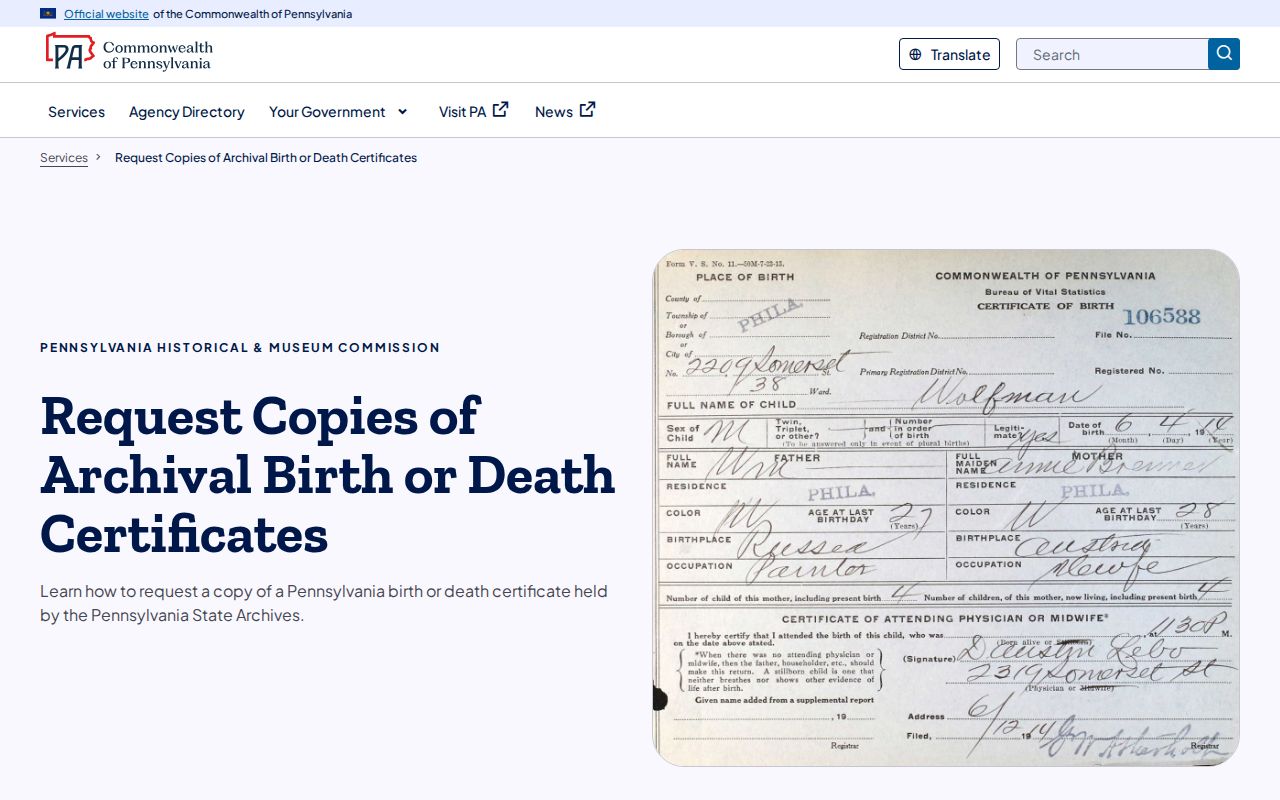
The archival request channel is a way to obtain a qualifying historical record, not a live directory of Reading residents.
Verifying a Reading Resident Lookup
Use two independent records before deciding that two results describe the same person. Start with a lawful local clue such as a known address, approximate event date, known spouse, business connection, parcel number, or docket number. Preserve the returned name form, county, date, and record number. Then look for a second record that agrees on meaningful details rather than on the name alone.
- For a property question, search the specific parcel by address, owner, or parcel ID and record situs and assessed-owner fields separately.
- Use the Recorder’s grantor, grantee, document-date, or legal-description search to check a recorded ownership transfer.
- When a public court connection is relevant, narrow UJS to Berks and compare the exact party name and docket details.
- For an old event, use an Archives index or the Register of Wills’ proper procedure, then ask the custodian about a copy if needed.
- Same-name match
- A potential match that has not been tied to a second, independent detail such as parcel, date, docket, or relationship.
- Parcel
- The county’s identified property unit. It is more stable than a street number when tracing a specific property.
- Legal description
- The lot, block, subdivision, or boundary wording carried in a land document, which can connect deeds across address changes.
Conflicting information should stay conflicting. An assessed owner, a deed party, a directory subscriber, and a case participant may all be different claims about a person. The street-by-street property path is covered separately in the Reading Street Directory.
Reading Resident Lookup Estate Leads
The Berks Register of Wills keeps probate documents and Orphans’ Court files, and describes permanent records as a genealogy resource. For estate work, begin with the decedent’s name and death period, then ask the office for the estate, docket, or copy process. An estate record can identify a personal representative, but a surname match does not establish an heir or relationship.
Older Reading research often needs a second channel. The Pennsylvania Room at Reading Public Library holds telephone books, yearbooks, maps, census, church, and cemetery material. The Berks History Center’s library indexes include cemetery, church, and PASSING SCENE material. Those sources can clarify a spelling or time period, but a directory or yearbook result is historical context, not confirmation of someone’s current location.
Note: Call the collection or custodian with the name, approximate year, and record type before relying on an unverified catalog description.
Reading Voter Lookup Boundaries
Pennsylvania Voter Services is intended for an elector’s individual registration-status and election-information check. It is not a public name browser. Berks Election Services maintains local registration data and has a formal request path for specialized registration lists, street listings, labels, and electronic material. The request requires an affirmation under 25 Pa.C.S. §§ 1207(b) and 1404.
Official voter material can concern registration administration, party or status, precinct, district, and participation history. It never reveals ballot selections. Protected participants and confidential identifiers stay restricted. A search that needs an official list should be directed to Election Services for the documented request and use limits, not improvised from the individual service.
Privacy Limits in a Reading Resident Lookup
Some record trails stop by law, and that boundary matters. Pennsylvania’s Address Confidentiality Program, also called Safe at Home, supplies qualifying survivors with a substitute mailing address for specified records. Vital records are confidential in the Department of Health’s custody. Court policy protects various sensitive identifiers and case types. PennDOT personal driving data is not an address-search fallback. A result that is not public is not a gap to work around.
For a real factual error, save the portal result, document number, and date, then contact the office that created the record. Assessment handles its property data, the Recorder handles recorded documents, Election Services handles voter data, and City departments handle their own files. Pennsylvania’s Right-to-Know Law, Act 3 of 2008, does not require an agency to create a new resident list or release a record made confidential by another law.
Lawful use. Use a Reading resident lookup only for a specific, lawful personal purpose. Public information must never be used to stalk, harass, threaten, or intimidate another person.
When the official record trail ends, the sound fallback is a narrow request to the proper custodian, librarian, or archives staff member. Compiled people-search services can be stale or misattributed; no such service is recommended here.